
Ward Monitor
Making operational data easier to read.
- My role
- Full-stack frontend and IoT prototyping
- Built with
- Angular, TypeScript, ESP32, MAX30100, MLX90614, Lucide icons
The problem
An operational monitoring interface needs to make important states easy to find. Warning, critical, offline and unknown readings should remain distinguishable without requiring someone to read every label on every card.
My contribution
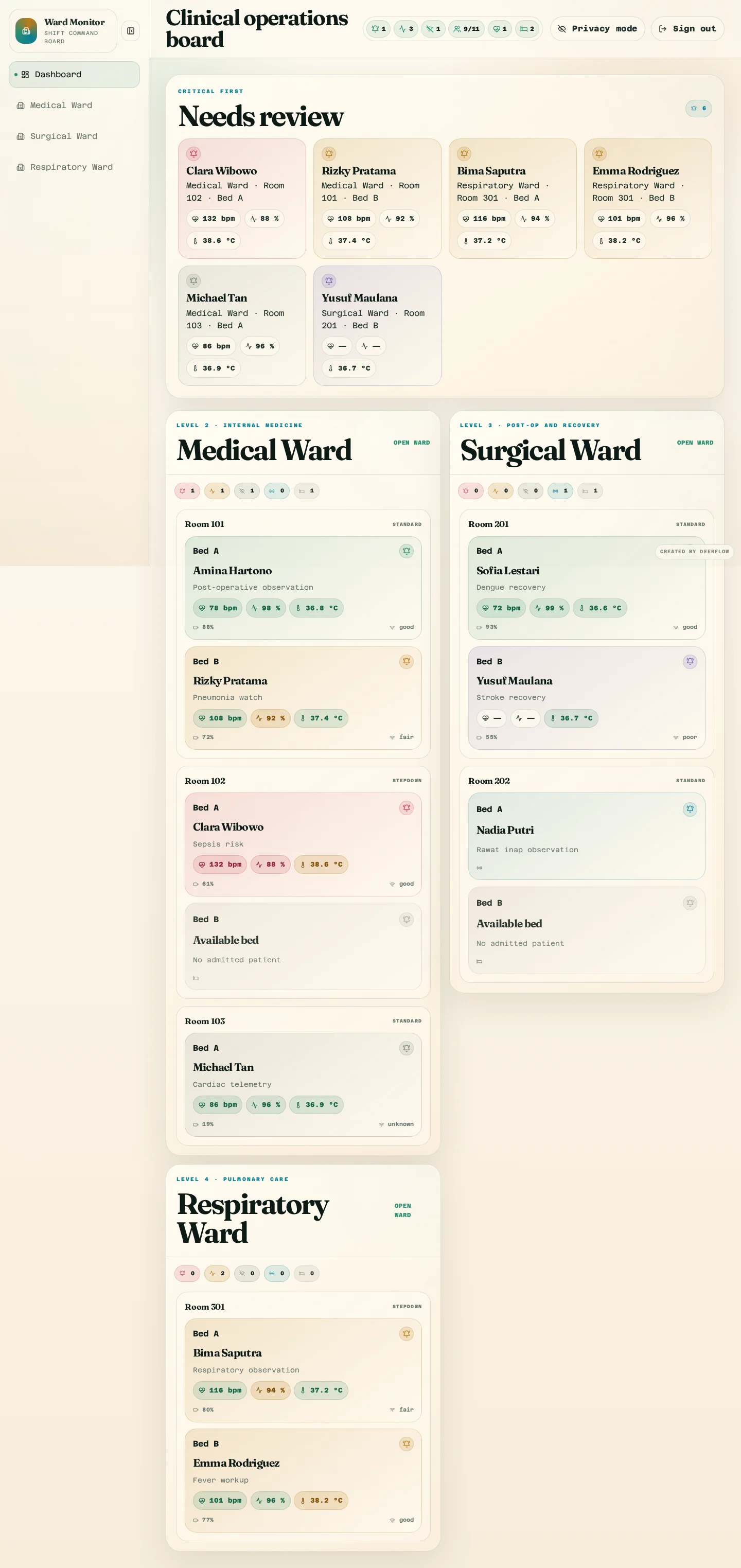
I explored a ward-oriented interface that groups monitored patients by ward, room and bed. The dashboard brings priority items forward and provides compact status summaries, privacy controls and paths toward more detailed views.
Decisions that shaped it
Color, icons and text work together to convey state. A missing reading must remain unknown rather than turning into a reassuring value. The interaction model focuses on quick scanning, with routing and authentication seams prepared for a backend.
The related ESP32 repository includes simulated vital-sign generation and Firestore upload structures. Those prototyping tools are distinct from a clinically validated monitoring product.
Where it stands
This is an interface and telemetry prototype. The screenshot contains synthetic patient information and demonstration readings. It is not evidence of clinical deployment, medical accuracy or real patient data. A production integration would need its own hardware, backend and operational validation.